Teaching philosophy
AI literacy is the capacity to understand, question, build, and judge intelligent systems.
My teaching is organized around a conviction that access and rigor are not competing goals. Learners can engage deeply with complex AI ideas when the learning environment provides multiple entry points, authentic purpose, visible systems, and opportunities to revise their thinking.
A plural model of AI literacy
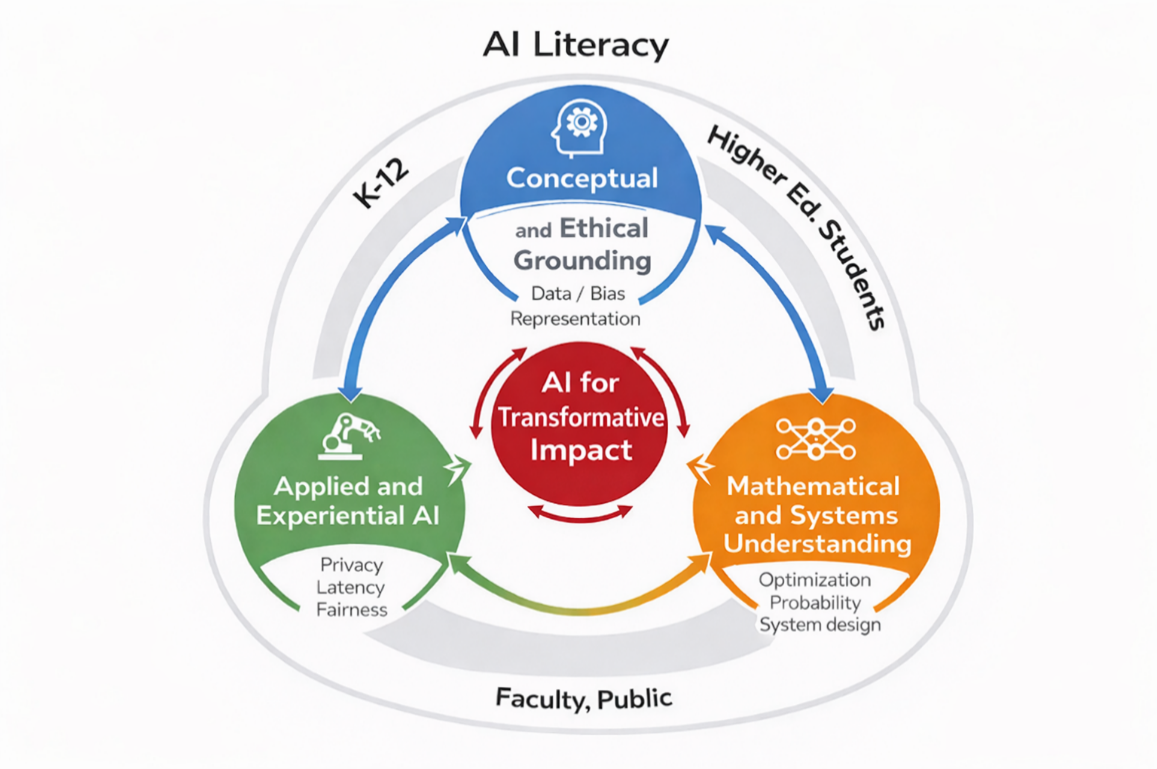
AI literacy is not a single skill, a prompt-writing technique, or one survey course. It is a set of complementary ways of understanding and engaging with intelligent systems. Learners need conceptual language for data, bias, representation, and ethics; mathematical and systems understanding for probability, optimization, and design tradeoffs; and applied experiences in which models sense, decide, and act in meaningful contexts.
These dimensions should not be taught as isolated layers. A learner who deploys a model on a sensor-equipped device encounters them simultaneously: the data are situated, model choices create tradeoffs, hardware imposes constraints, and the resulting system affects people and environments.
01
Make complex systems visible.
I ask learners to move beyond black-box use. Scratch implementations, visualizations, sensors, microcontrollers, model diagnostics, and worked examples reveal how systems transform data into decisions. Visibility creates the foundation for technical judgment.
02
Design multiple entry points without lowering the ceiling.
Learners arrive with different mathematical preparation, coding experience, identities, and confidence. Tiered laboratories, modular reference materials, collaborative tasks, and progressively challenging projects allow students to enter at a productive point while retaining opportunities for advanced exploration.
03
Connect technical learning to authentic purpose.
Projects become more consequential when students address problems that matter: community health, agriculture, environmental monitoring, accessibility, care, public safety, or institutional decision-making. Purpose helps learners connect technical choices with the people and contexts those choices affect.
04
Make reasoning public and revisable.
Poster sessions, peer review, project demonstrations, reflective tasks, and conversations with guest experts require students to justify decisions and respond to critique. Learning becomes stronger when reasoning is visible, accountable, and open to improvement.
05
Treat evidence as a design partner.
I revise courses in response to student feedback, performance, disciplinary change, and reflection. New AI model releases may require redesigned laboratories. A partially successful course integration may reveal the need for a more intentional syllabus structure. Teaching quality is not a fixed trait; it is an iterative design practice.
Care and representation are part of rigor.
Students learn demanding material more effectively when expectations are transparent, feedback is meaningful, and asking questions is safe. As a Latina computer scientist and educator, I also understand that representation can shape whether learners imagine themselves as legitimate participants in technical fields.
“As a fellow Hispanic in this field, I’m proud to share this space with you and to learn from someone who represents our community so strongly.”
Graduate student, Fall 2025
The outcome I seek
I want learners to leave my courses with more than functional competence. They should be able to explain how an AI system works, identify what it assumes, evaluate where it may fail, communicate technical choices, and decide whether a proposed use is responsible. They should also see themselves as people who can contribute to the field—not only by making systems more capable, but by making the decisions around them more thoughtful.