Teaching portfolio
Teaching AI as a system learners can question, understand, build, and improve.
My portfolio spans introductory engineering, graduate AI and data science, faculty development, K–12 teacher learning, and informal education. Across contexts, the goal is consistent: make demanding ideas tangible without removing their complexity.
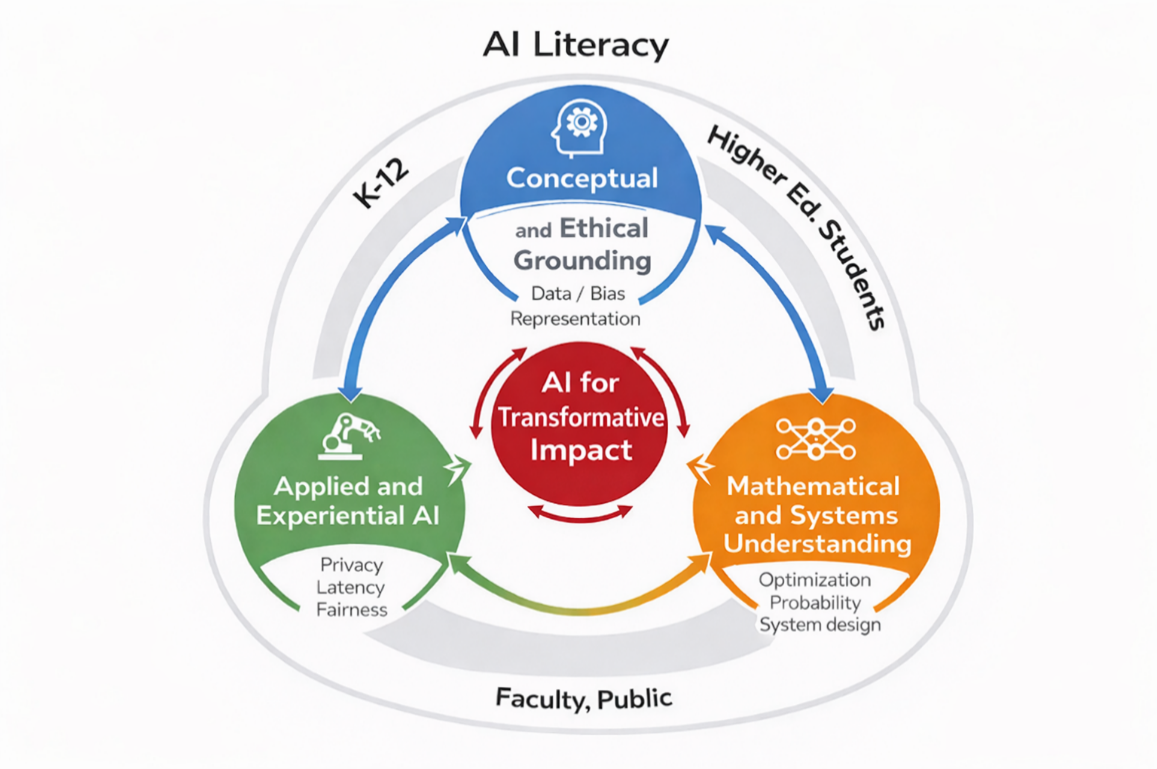
The framework behind the course designs
AI literacy is developed through three mutually reinforcing dimensions: conceptual and ethical grounding, mathematical and systems understanding, and applied and experiential AI. I use the framework to sequence content, select activities, design assessments, and identify what student growth should look like.
Evidence in practice
Student work makes learning visible.
The artifact below show students translating technical ideas into defensible decisions, functioning systems, and communication for authentic audiences. They are presented not as isolated products, but as evidence of inquiry, iteration, synthesis, and professional growth.
Student Poster Presentations
Open full-screen PDFStudent authorship and privacy. Student work is shared with permission and presented to recognize student learning and authorship. Identifying information should be removed when appropriate. Please do not reproduce or distribute student artifacts without authorization.
Extended teaching portfolio (TEA assignments)
Teaching Portfolio
A fuller account of my teaching philosophy, course and curriculum design, inclusive and authentic learning practices, evidence of effectiveness, reflection, and continuing development.
Courses and learning experiences
Classroom, project, notebook, poster, or curriculum image
AI Fundamentals Faculty Microcredential
Helps faculty move beyond generative-AI tool use toward a stronger understanding of AI systems and educational choices.
Conceptual AI literacy; responsible integration; examples across disciplines; discussion and application.
students presenting posters, Jupyter notebook, or model-development workflow
Applied Machine Learning II
An advanced, applied course designed from the ground up around rigor, accessibility, reusable resources, and authentic model development.
Public GitHub learning ecosystem
Scratch implementations in Jupyter notebooks
Hands-on laboratories
Curated summary handouts
Public final-project poster session
Students reported stronger confidence in machine learning concepts and practical application. Instructor ratings exceeded department and college averages across clarity, feedback, engagement, and instructional value.
AI Systems poster session, guest speaker, project critique, or student prototype
Artificial Intelligence Systems
Project-based design and evaluation of intelligent systems with emphasis on systems thinking, deployment, professional context, and responsible decision-making.
Authentic AI systems projects
Guest experts from industry and research
Public poster sessions
Iterative course redesign
Technical and organizational decision-making
Guest speakers became advisors and mentors to students, creating professional relationships beyond the course. Students described the poster session as academically valuable and professionally meaningful.
tiered lab, neural-network visualization, or students working in Jupyter
Applied Deep Learning
A rapidly updated deep-learning course using tiered laboratories and multiple entry points into advanced architectures and emerging methods.
Discovery Tasks
Implementation Tasks
Reflection Tasks
Visualization Tasks
Challenge Tasks
Interactive notebooks and practical model analysis
Students highlighted clear explanations of complex topics, strong organization, hands-on learning, critical thinking, approachability, and meaningful feedback. The Associate Provost recognized sustained excellence in the classroom.
summary PDF, mathematical visualization, or problem-solving session
Mathematical Foundations for Data Science II
A mathematically rigorous and practically grounded course built around original modular references, worked examples, and transfer to AI systems.
Original summary PDFs
Worked examples and visualizations
Connections between mathematical mechanisms and AI decisions
Modular reference tools
Students reported using the summary materials for course review and interview preparation. Ratings for availability and positive learning environment reached 5.00/5.
first-year engineering design team, prototype, or class activity
Engineering Design and Society
An introductory design context used to test how AI can be introduced beyond large language models and incorporated more intentionally into early engineering education.
Team-based engineering design
Scaffolded AI examples
Reflection on partial implementation
Evidence-driven syllabus redesign
The initial integration produced useful evidence for a more intentional redesign with the course coordinator and a possible future AI designation.
faculty workshop, group activity, or presentation
AI Fundamentals Faculty Development
Professional learning that connects AI concepts, limitations, instructional implications, and responsible integration across disciplines.
Conceptual AI literacy
Cross-disciplinary examples
Discussion and application
Institutional decision-making
Online and in-person delivery
Sessions reached faculty and staff at UF, community colleges, and higher-education institutions across the United States and generated evidence about the needs faculty face when integrating AI.
Edge AI board, sensor prototype, or course design planning
Edge Intelligence / Edge AI
A new course connecting local AI deployment, sensors, microcontrollers, model training, system constraints, and socially meaningful applications.
Hands-on Edge AI deployment
Microcontrollers and sensors
Community-centered projects
Cloud-to-edge tradeoffs
Undergraduate and graduate pathways
Supported through the Provost AI Course Designation Incentive Program and planned as the first course of its kind in the college.
machine learning workflow, student notebook, or model comparison
Applied Machine Learning
Applied model selection, evaluation, interpretation, and communication within the graduate data science pathway.
Model comparison
Applied problem solving
Transparent project criteria
Interpretation and responsible use
The course established foundations that feed directly into Applied Machine Learning II.
first-year students using FPGA or embedded systems hardware
Adventures in ECE Design
Hands-on embedded-systems learning with an international Collaborative Online International Learning experience.
Embedded systems
Hands-on hardware
Active learning
International virtual exchange
Collaborative design
Connected UF students with peers at Universidad Icesi and created an accessible entry point into electronics and computing hardware.
Selected teaching artifacts
Learning ecosystems, not isolated assignments.
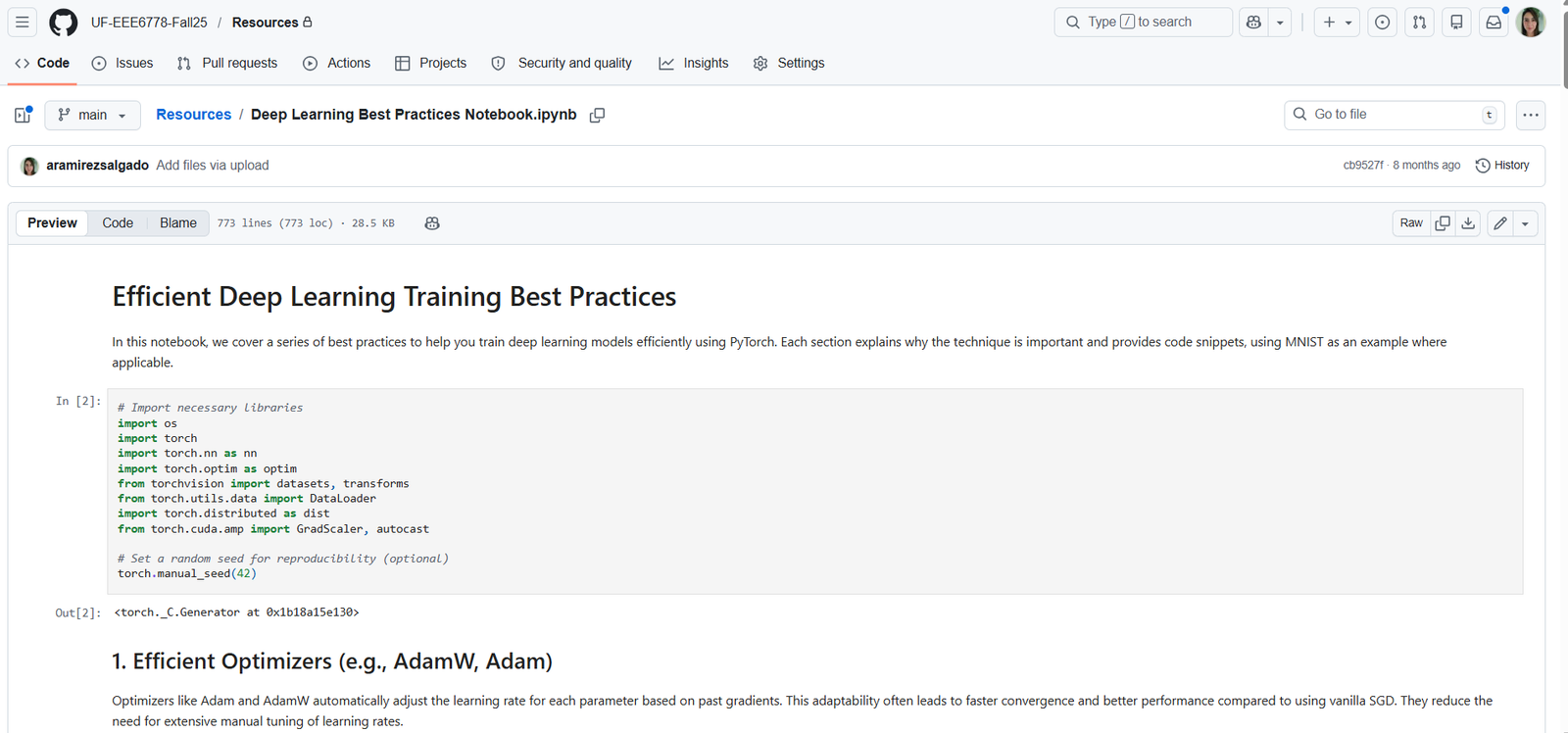
Public learning resources
Structured Canvas environments, GitHub repositories, summary handouts, scratch implementations, and reusable Jupyter notebooks extend learning beyond the semester.
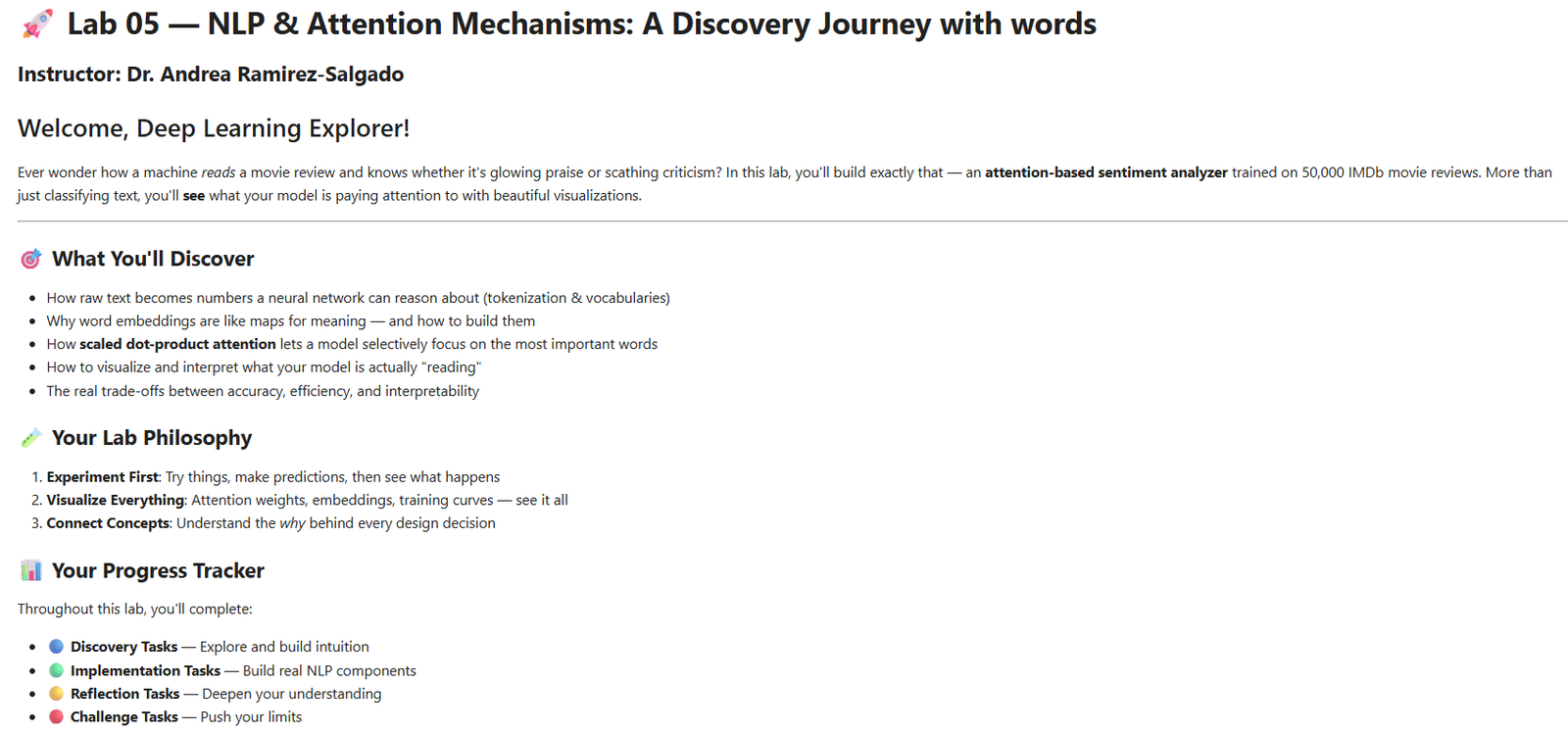
Tiered challenge laboratories
Discovery, implementation, reflection, visualization, and challenge tasks create multiple entry points while preserving depth and student agency.
Add poster-session imageStudents presenting projects to faculty and peers.
Public capstone experiences
Poster sessions make technical synthesis visible, invite external feedback, and connect students with faculty, mentors, and professional communities.
Add summary-PDF imageModular mathematical reference, worked example, or visualization.
Modular reference tools
Original summaries and worked examples help learners revisit difficult ideas, connect theory to practice, and build durable reference collections.
Evidence of teaching effectiveness
Strong ratings, meaningful feedback, and visible student work.
4.91
Applied Deep Learning
Spring 2026 · 34 students
4.89
Mathematical Foundations II
Spring 2026 · 11 students
4.91
Applied Machine Learning II
Fall 2025 · 35 students
4.75
AI Systems
Fall 2025 · 35 students
The Associate Provost for Academic and Faculty Affairs recognized this record as “sustained excellence in the classroom.” Ratings are reported on a five-point scale.
Student voices
“You have put so much genuine effort into making sure we succeed, treating these courses as learning opportunities and not simply courses we have to pass.”
EEE 6778 student, Fall 2025
“This course significantly strengthened my understanding of machine learning concepts and their practical applications, and I feel much more confident in my skills.”
EEE 6778 student, Fall 2025
“The final poster presentation was an incredibly valuable experience both academically and as a meaningful networking opportunity with peers and faculty.”
Graduate student, Spring 2026
Faculty development
Through the UF AI² Center, I facilitate AI fundamentals professional development for faculty and staff at UF, community colleges, and higher-education institutions across the United States. More than 100 participants engaged in these sessions during the reporting year.
Add faculty-development imageWorkshop discussion, collaborative activity, or presentation.
Next: Edge Intelligence / Edge AI
A Provost initiative award supports development of the first co-listed undergraduate and graduate Edge AI course in the Herbert Wertheim College of Engineering. The course will create a direct curricular bridge between my research, tangible AI systems, and engineering practice.
Add Edge AI course imageMicrocontroller, sensor array, prototype, or course-design session.