Research
When does AI literacy become durable enough to change what people can imagine, build, and question?
My research treats AI literacy as an integrated capacity: conceptual and ethical grounding, mathematical and systems understanding, and applied experience. Edge intelligence provides a powerful setting for studying these dimensions together because learners must connect data, models, devices, constraints, and human purpose in one visible system.
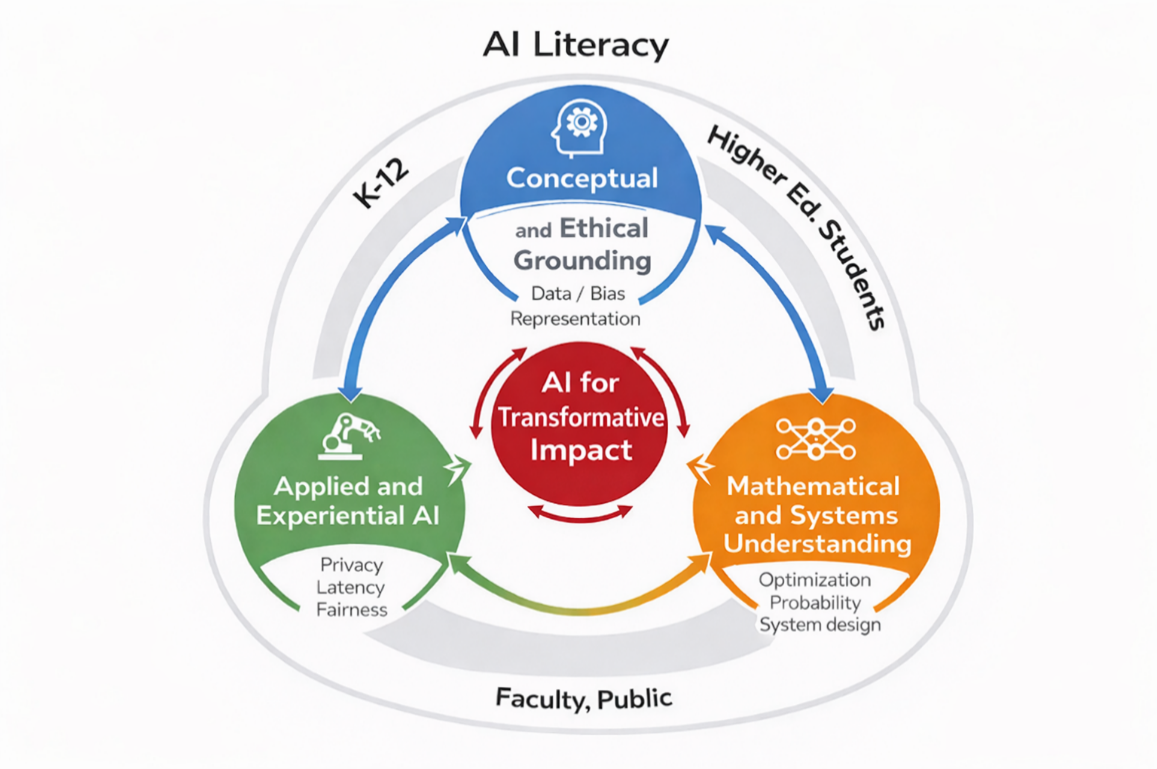
A framework for AI literacy across education and society
The framework is organized around three interacting dimensions. Conceptual and ethical grounding addresses data, bias, representation, and the questions learners should ask before accepting a system’s outputs. Mathematical and systems understanding develops the capacity to reason about optimization, probability, tradeoffs, and system design. Applied and experiential AI makes those ideas tangible through models, sensors, devices, and authentic problems.
The center of the framework is AI for transformative impact. The outer ring includes K–12 learners, higher-education students, faculty, and the public because AI literacy should not be reserved for a single discipline or level of expertise.
Research streams
AI literacy through tangible systems
How do learners’ understanding, interest, self-efficacy, identity, and decision-making change when AI becomes a system they can inspect, deploy, and modify rather than a remote black box?
Edge intelligence for social good
How do community-centered projects in agriculture, health, environmental monitoring, and care connect technical learning with purpose and sustained participation?
Identity, equity, and participation
Which intrapersonal, interpersonal, cultural, and institutional conditions expand or constrain learners’ sense of belonging and future possibility in computing and engineering?
Digital minds and engineering formation
What competencies and decision frameworks will engineers need when the sentience, welfare relevance, or moral status of advanced AI systems is uncertain?
Methods and research design
- Design-based and research-to-practice curriculum development
- Mixed-methods studies combining surveys, observations, interviews, and artifacts
- Qualitative inquiry and phenomenology
- Systematic literature reviews and framework development
- Competency modeling and evidence-centered design
- Participatory and teacher co-design approaches
Research translation
The scholarship is designed to move. Findings inform curriculum revisions, faculty development, graduate AI courses, community learning, museum programming, institutional strategy, and new proposal development.
Recent dissemination spans NeurIPS, ASEE, AERA, NARST, IEEE FIE, ACM, and journals in computing education, educational technology, and learning sciences.
Funded research
AHA! AI Hardware Adventures
As co-principal investigator on NSF Award 2405373, I contribute to a multi-state project that develops, pilots, refines, and disseminates Edge AI and microelectronics curriculum for teachers and young learners. The work uses teacher co-design and community-centered projects to connect technical learning with altruistic applications.
- $1,487,350 collaborative NSF DRK–12 award
- Teacher co-design across Florida, Texas, and Kansas
- Classroom and museum implementation
- Curriculum, professional development, research, and dissemination
Add AHA! research imageTeacher professional development, AHA! board, student showcase, or community-centered prototype.
Research mentorship as infrastructure
I mentor learners across undergraduate, master’s, and doctoral levels. Recent work includes advising an undergraduate AI Scholar studying energy tradeoffs between Edge and cloud AI, pairing undergraduate and graduate researchers for near-peer collaboration, guiding master’s capstone projects, advising honors theses, and serving on graduate committees across engineering and education.
Add research mentoring imageStudent poster, lab meeting, conference presentation, or advising conversation.